

3 Powerful Steps to Renewing the Mind
I hope you love the products and resources I recommend here at A Little R & R. Just so you know, it is possible that I get a commission and collect income from the links on this page. As an Amazon Associate I earn from qualifying purchases. Click here for more info.
Have you ever noticed how quickly one thought can turn into ten?
You’re washing dishes, driving, folding laundry, or getting ready for bed—and suddenly your mind starts replaying an old hurt.
One thought leads to another.
Before you know it, you’re angry, discouraged, anxious, or feeling sorry for yourself.
I’ve been there.
One reason I care so deeply about this subject is that I’ve had to practice it myself.
I’ve learned that mind renewal isn’t something we master once and graduate from. It’s something we practice every time we choose God’s truth over our default way of thinking.
For years, one of my biggest struggles wasn’t what I was doing—it was where my mind went when I wasn’t paying attention.
That’s why learning to renew my mind became so important.
The Bible doesn’t tell us to simply think positive thoughts. It tells us to renew our minds.

And do not be conformed to this world, but be transformed by the renewing of your mind, that you may prove what is that good and acceptable and perfect will of God.
How Do You Renew Your Mind?
Biblical mind renewal involves three things:
✔️ Make God’s Word your standard.
✔️ Capture thoughts that contradict God’s truth.
✔️ Bring your thinking and behavior into alignment with God’s Word.
Let’s look at each one.
What Happens When We Don’t Renew Our Minds?
I believe this is why, in the New Testament, we see Paul repeatedly urging Christians to renew their minds and why we read from cover to cover about the importance of memorizing and meditating on Scripture.
On the heels of reminding believers of their responsibility to the church and urging them to greater spiritual maturity, Paul goes on to remind them why there should be a great distinction between the world and the church and that the mind plays a crucial role in this distinction.
He starts off with this very direct statement:
“This I say, therefore, and testify in the Lord, that you should no longer walk as the rest of the Gentiles walk, in the futility of their mind,”
If we take this passage from Ephesians 4:17 to Ephesians 5:7 in the context of the whole book and in agreement with the whole passage itself, we can see that when Paul refers to the Gentiles, he’s referring to Gentile Christians.
In other words, he is saying, “Don’t behave as other Gentile Christians behave.”
How were they behaving?
The word “futility of their mind” means void of truth, inappropriate, depraved, perverse, frail, lacking vigor.
I think each definition gives the phrase an almost 3-D effect.
Their minds were filled with lies and distortions of truth and inappropriate, depraved, and perverse thinking, but their minds were also weak and lazy.
They lacked the energy and will to control their thinking, so they allowed their thoughts to roam wherever they pleased.
Have you ever had that happen?
If we don’t intentionally disciple our minds, our minds will wander wherever our emotions, experiences, culture, and desires take them.
This often happens when we’re performing a menial task, such as housekeeping or driving.
Our minds start on one thought, which leads to another and then to another; and before long, our minds have led us into depression and anger because, if left to themselves, our mind never leads us to good things.
When My Mind Started Running the Show
This was one of the strongest habits in my life to break. I seemed to be able to overcome everything else, but I struggled so hard to control my mind.
Whenever I was performing a menial task, my mind would wander into victimhood and negativity, rehearsing old hurts and wounds.
Before long, I was angry and upset—and sometimes taking it out on my family and friends.
I eventually realized something:
My thoughts were discipling me.
And I needed to learn how to disciple my thoughts.
What Should We Do With Our Thoughts?
I had to work very hard at renewing the mind and discipling it to do what Philippians 4:8-9.
Finally, brethren, whatever things are true, whatever things are noble, whatever things are just, whatever things are pure, whatever things are lovely, whatever things are of good report, if there is any virtue and if there is anything praiseworthy—meditate on these things.
I still often stop and ask myself:
- Is this true and noble?
- Is this just and pure?
- Is this lovely or of a good report?
- Is there anything virtuous or praiseworthy about this thought?
If the answer to any of these questions is no, then I know I need to take that thought and submit it to the power of God’s Word.
5 Signs Your Mind Needs Renewal
You might:
- replay old hurts repeatedly
- assume the worst
- constantly rehearse what other people did to you
- struggle to believe what Scripture says about you
- make decisions primarily from fear or emotion
If you recognize yourself in these, don’t condemn yourself.
Recognition is actually the beginning of renewal.
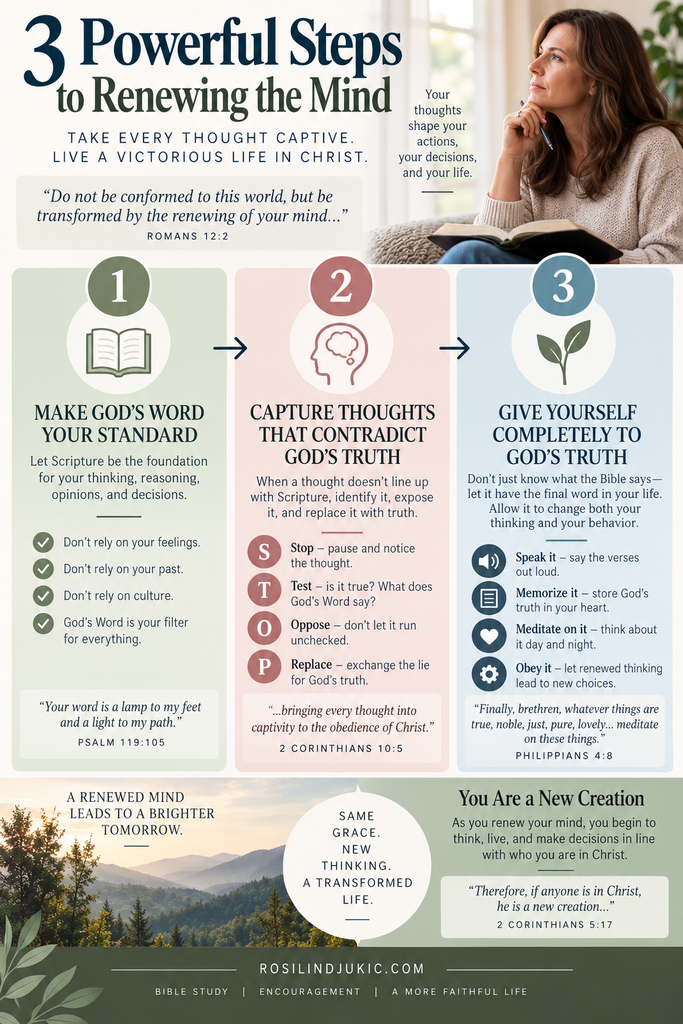
3 Powerful Steps to Renewing the Mind
1. Make God’s Word Your Standard
Make God’s Word your standard of thinking, reasoning, opinions, and philosophy.
God’s Word must become the foundation of your worldview. It must be the filter for your thinking, your opinions, your philosophy of life and ministry, and for every decision you make.
Your feelings aren’t your standard.
Your past isn’t your standard.
Your culture isn’t your standard.
Your friends aren’t your standard.
God’s Word is your standard.
When Scripture becomes the filter through which you evaluate your thoughts, opinions, decisions, relationships, and circumstances, your entire worldview begins to change.
Ask yourself: What area of my thinking have I been allowing something other than Scripture to define?
2. Capture Every Thought That Contradicts God’s Truth
Paul tells us to take thoughts “captive to the obedience of Christ.”
When a thought fails to measure up to God’s Word, you must capture it and convert it to truth.
Find Scripture verses that expose that thought for the distortion that it is and begin reflecting that thought through the truth of God’s Word.
Here’s an example.
Distorted thought: “It is okay to use profanity when you’re trying to make a strong point about something.”
God’s Word says: “Let no corrupt word proceed out of your mouth, but what is good for necessary edification, that it may impart grace to the hearers.” Ephesians 4:29
When a thought comes:
STOP
Name it: What am I thinking?
Test it: Does this agree with Scripture?
Capture it: Don’t allow it to run unchecked through your mind.
Replace it: What does God’s Word say instead?
Then your profanity example.
But I’d change the example to something that is more emotionally relevant to your audience.
For example:
Distorted thought:
“If I can’t control this situation, something terrible is going to happen.”
God’s truth:
“God is in control, and I can trust Him even when I don’t understand what He’s doing.”
Scripture:
“When I am afraid, I will trust in You.” — Psalm 56:3
3. Submit Your Thinking to God’s Truth
Knowing what Scripture says isn’t enough.
We have to allow Scripture to have the final word in our lives.
Completely give yourself over to the truth of God’s Word.
We must reject every temptation to rationalize away the truth of God’s Word and simply let it have the final word in our lives.
Once we have discovered what God’s Word says about our distorted thought, we must bring our thoughts and behavior into alignment with that truth.
You can do that in three ways:
Speak those verses out loud to yourself.
Memorize those verses so that you can recall them anytime, anywhere.
Meditate on those verses as you fall asleep every night so that the truth of God’s Word soaks down deep in your heart and begins a renewing process in your mind to correct the distorted thoughts the enemy has planted there.
Paul doesn’t tell us to stop thinking.
He tells us to learn what to think about.
Paul goes on to further in Ephesians to describe these Gentile Christians with weak and undisciplined minds:
“…having their understanding darkened, being alienated from the life of God, because of the ignorance that is in them, because of the blindness of their heart; who, being past feeling, have given themselves over to lewdness, to work all uncleanness with greediness.”
There are six more things here that describe these Gentiles:
- Their understanding is darkened
- They are alienated from the life of God
- They are filled with ignorance
- Their hearts are blinded
- They are numbed and calloused
- They are given over to outrageous lust and shamelessness
So, their minds are not only undisciplined, but their way of thinking and perceiving the world is obscure. It is like they’re simply feeling their way along in their effort to make wise decisions.
Because of this, they don’t have the life of Christ in them.
They are cut off from the vine (John 15) and are estranged. They have no life source in them, so they completely lack knowledge and moral guidance.
Not only this, but their hearts are also blind.
I find it fascinating that the Greek word used here doesn’t mean the inability to see. It means hardened, calloused, dulled perception, inability to mentally discern, a dull mind, stubbornness.
These were Christians who were living in delusion and stubbornly refused to see the truth.
Their understanding was so darkened and filled with ignorance that their hearts grew calloused, hard, and stubborn so that they were incapable of mentally discerning or perceiving truth.
How did these Christians arrive at such a state?
Because their hearts were “past feeling” or numbed and calloused.
They had repeatedly ignored the conviction of the Holy Spirit; they could no longer feel His pain and grief over sin and, as a result, had given themselves over to their vices, excesses, and unbridled lust.
Paul then turns around to address the Ephesian Gentile Christians and says:
“But you have not so learned Christ, if indeed you have heard Him and have been taught by Him, as the truth is in Jesus…
What is the truth?
That you need to shed your grave clothes – the clothes that once identified you as an unbeliever, as a sinner- and start renewing your mind so that your mind begins behaving in accordance with who you really are!
The Christians that Paul describes above are believers who have come to Christ, but still walk around with an old identity.
Their behavior still reflects the person that died with Christ. Their mind doesn’t reflect who they are in Christ.
This is why renewal of the mind is so important.
If we get saved and fail to renew our mind, we will battle our old vices, our old mindsets, our old defaults, and all of those things that used to define us when we lived in the world.
Being saved doesn’t change those things.
There is a struggle in the process of being renewed, just as a caterpillar must struggle to exit the cocoon as a butterfly. And that struggle is what strengthens us spiritually.
Notice that Paul says, “put off….your former conduct” and “put on the new man”. Your spiritual clothing tells a lot about who you are on the inside.
Try This: Renew One Thought Today
Don’t try to fix your entire thought life today.
Start with one thought.
The thought I’m struggling with:
- Is it true?
- What does Scripture say?
- What truth will I choose instead?
- What will obedience look like?
Tools That Help Me Renew My Mind
These are a few tools that have helped me interact with Scripture more intentionally. You don’t need fancy tools to renew your mind—the Word of God is the essential tool. These simply help make Scripture more accessible throughout the day.
- Find all my favorite resources in one place in my Amazon Storefront
A Bible - A journal or notebook
- Pens
- Bible highlighters
- Colored pens or pencils if you enjoy Bible journaling
- Sticky notes or tabs for marking important passages
Ready to Start Renewing Your Mind?
Grab these Bible verse Cards to help you replace worldly thinking with the truth of God’s Word.

These verses are especially helpful when you need a quick reminder to stop, recognize what’s happening in your thoughts, and return to God’s truth.

Much of what I’ve learned about discipling the mind was influenced by years of Bible teaching and conversations with my dad, Dr. Dean Hackett. I’m grateful that he allowed me to adapt this portion of his teaching for this article.


Rosilind, Thank you for this insightful message. It really hit a chord with me. I have been emotionally eating for all of my life (63 years!) I have never shed my grave clothes!! So I keep reverting back to the old me in reaction to my emotions. I have always acted the same expecting a different outcome. My spiritual clothing is about to change!
Oh my friend, I relate to your struggle so much. There are times I see that I’ve picked up the grave clothes and put them back on! Daily dying to ourselves and clothing ourselves in our new apparel. It is something we must consciously do until it becomes second nature.
google is giving your new age, chakra jewelry advertisements on your page.. you should probably address that.