
Psalm 16 – Verse by Verse – What If God’s Boundaries Are Where Joy Begins?
I hope you love the products and resources I recommend here at A Little R & R. Just so you know, it is possible that I get a commission and collect income from the links on this page. As an Amazon Associate I earn from qualifying purchases. Click here for more info.
Why did I think I could live my life with boundaries in some areas and not in others?
That question hit me like a lightning bolt during my Bible study this morning.
I realized something uncomfortable about myself.
I actually like boundaries—as long as I’m the one deciding where they belong.
I have boundaries in my marriage. I don’t use profanity. There are movies and TV shows I simply won’t watch. There are things I have decided are off-limits because I know they aren’t good for me.
But then there are other areas where I want freedom without restraint.
I want to decide what is good for me.
I want to decide where the line should be.
And if God’s boundary happens to fall somewhere different from mine?
Well…that’s where the struggle begins.
We live in a culture that tells us, “Do what makes you happy.”
And sometimes, without even realizing it, we bring that philosophy into our relationship with God.
We begin to believe that God’s highest priority is our happiness—that if something makes us happy, God must approve of it.
But what if that’s not true?
What if God’s boundaries aren’t the things standing between us and joy?
What if they’re actually the things protecting our joy?
That’s the question that led me to Psalm 16.
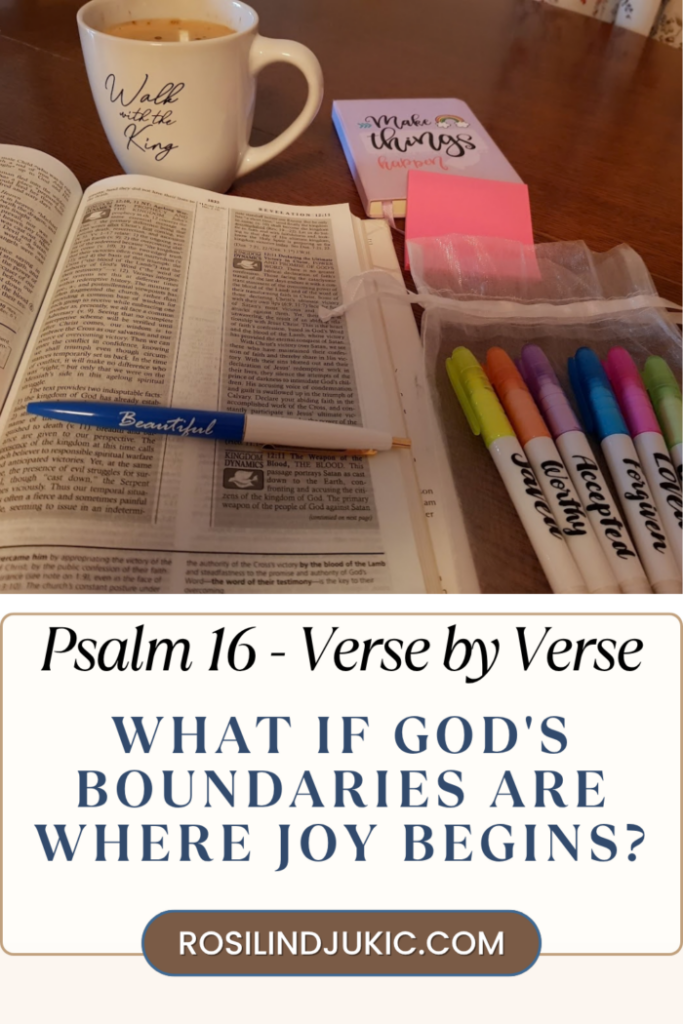
Today we’re going to walk through Psalm 16 verse by verse and ask one question:
What does this psalm teach us about finding joy inside the boundaries God has given us?
As we move through the psalm, you’ll notice something beautiful:
David doesn’t describe God’s boundaries as restrictive.
He describes them as safe, satisfying, pleasant, and ultimately joyful.
V. 1 — God Is My Refuge
“Preserve me, O God, for in You I put my trust.” Psalm 16:1
A boundary can feel restrictive when we see it as something keeping us from what we want.
But a refuge is also a boundary.
David is saying to God, “Guard over me, O God, because You are my shelter, my refuge.” When we think of a refuge or shelter, we think of a hiding place.
And when we find a hiding place, it is usually a small, confined place. We willingly stay within its confines because we know that the moment we step outside that shelter, we are exposed to danger.
The walls of a shelter keep something out.
And sometimes God’s boundaries work the same way.
They’re not there because God doesn’t want us to experience life.
They’re there because He knows what is waiting outside the boundary.
Where have I been viewing one of God’s boundaries as a restriction rather than protection?
V. 2 – God Himself is my source of goodness
“O my soul, you have said to the Lord, ‘You are my Lord, my goodness is nothing apart from You.'” Psalm 16:2
The word goodness refers to our well-being: prosperity, favor, pleasantness.
Also, there is no translation for “is nothing apart from You”, giving the sense that this verse could read that the Lord is his goodness.
Which is, in fact, what David is saying.
And we see that this is his soul saying this. The soul: mind, will, emotions.
So, David knows – not just in his mind, but he knows deep in his psyche… his will understands this, and his emotions agree that God is the source of all his goodness.
If God is truly my source, I don’t have to keep looking outside of Him for what only He can give me.
And when we know that, we realize that we don’t have to turn to any other source for fulfillment.
So, God is our place of refuge; it may be confining, but we don’t mind because we are safe from destruction. And it is in this confined safety that we find our source of fulfillment, prosperity, and all good things.
Where have you been turning to for your source of fulfillment?
V. 3 – My closest relationships influence my direction.
“As for the saints who are on the earth, ‘They are the excellent ones, in whom is all my delight.'” Psalm 16:3
There is a tendency to listen more closely to those we consider experts, because they have particular knowledge about a certain subject.
But we need to remember David’s words in Psalm 1, “Blessed is the man who walks not in the counsel of the ungodly…”
We see in these verses a boundary in friendships. Who are those whom he has chosen to be in his inner circle? He calls them “saints”.
While I firmly believe that we should have unbelievers in our lives at some level, we will run into great trouble if our inner circle consists of those who do not hold the same spiritual values as we do.
The Hebrew word is qados – consecrated ones.
He says that they are noble, mighty, and glorious. In other words, they are his heroes, his mentors.
These are the ones he wants us to look to, to invest in.
If all of our delight is in those who are not consecrated – set apart for holy use- we will find that their ungodly values will influence us negatively.
Who has the loudest voice in my life?
Not who has the most followers.
Not who I happen to spend the most physical time with.
Whose values are shaping mine?
Because our inner circle eventually becomes an inner voice.
Who are the people I look to for advice, approval, inspiration, and direction?
V. 4 – I don’t have to participate in what pulls my heart away from God.
“Their sorrows shall be multiplied who hasten after another god; their drink offerings of blood I will not offer, nor take up their names on my lips.” Psalm 16:4
Idolatry doesn’t always look like bowing before a statue.
Sometimes it looks like constantly checking what a celebrity thinks.
Sometimes it looks like looking to another philosophy for the peace only God can give.
Sometimes it looks like trusting a practice, personality, political ideology, relationship, or lifestyle to give us what only God can give.
Not only does David limit his inner circle of friendships to those who are set apart for God, but he refuses to engage with those who run headlong after other gods.
He says that their sorrows – pain, injury – will multiply one on top of another.
He refuses to take part in their idolatry, or even speak the names of their gods.
The question isn’t simply, “Do I have an idol?”
The better question is:
“What am I expecting to give me what only God can give?”
V. 5 & 6 – I can be content with the portion God has given me.
“O Lord, You are the portion of my inheritance and my cup; You maintain my lot. The lines have fallen to me in pleasant places; yes, I have a good inheritance.” Psalm 16:5-6
What if the boundary isn’t the problem?
This may be the most important idea in the entire psalm.
David doesn’t merely tolerate God’s boundary lines.
He calls them pleasant.
Think about that.
He isn’t saying, “God has drawn these lines, and I suppose I have to live with them.”
He’s saying, in essence:
“God gave me these boundaries, and I have discovered that they are good.”
David is content with the boundary lines God has set for him.
God had determined a “portion”, a ration, for him. An inheritance. And what is that portion, that inheritance?
God Himself!
Instead of trying to find fulfillment, rest, peace, tranquility, safety, healing… or whatever it is that he was looking for in advice, philosophies, and practices of other religions and rituals, David looked to God alone.
He refused to drink from the cup of the “drink offerings of blood” meant for other gods.
Instead, He knew where the boundary lines were drawn and found delight in them, because He was fully content with God as His portion.
Have you found a place of contentment in God’s boundaries?
V. 7 – God’s Word gives me counsel.
“I will bless the Lord who has given me counsel; my heart also instructs me in the night seasons.” Psalm 16:7
There are two things that stand out clearly in this verse.
David’s counsel came from God. Where do we find God’s counsel today? Through His Word.
Jesus said, “If you abide in My word, you are My disciples indeed. And you shall know the truth, and the truth shall make you free.” John 8:31-32.
If we want to live by God’s counsel, we must abide in His Word.
And when we abide in His Word, He gives us a clear promise: We will know truth, and this truth will make us free!
But David took it a step further. He didn’t just listen to God’s counsel; he meditated on this counsel.
“…my heart also instructs me in the night seasons”
This is a very interesting phrase, because the King James Version says “my reins”. Some translations use “heart”; others use “mind”, and the Hebrew word is literally translated “kidneys”.
Clearly, this is referring to the innermost part of us. The part of us that speaks to our subconscious in our sleep.
What we meditate on during the day is processed through our subconscious as we sleep. And David’s heart (or mind… or kidneys) were instructing him, chastening him, disciplining him, in the night.
How so?
Through God’s counsel that he had meditated on during the day.
What are you feeding your mind during the day?
Because what occupies your mind while you’re awake doesn’t necessarily stay there when you go to bed.
David had been meditating on God’s counsel—and God’s Word was still speaking to him in the night.
What would your mind be rehearsing tonight if it simply replayed what you fed it today?
V. 8 – When God is my standard, comparison loses its power.
“I have set the Lord always before me; because He is at my right hand I shall not be moved.” Psalm 16:8
When I looked at the Hebrew translation of this, I began to get a beautiful picture of what David was speaking about here.
The phrase “I have set” is referring to an equivalent, or resembling, becoming like something. That confused me at first, because I was struggling to understand how that fit in this verse.
And then the phrase came to me:
Do not compare yourself to others; compare yourself to Christ.
And I realized David is saying, “I am confident because I have set the Lord before me as my comparison. He holds the highest place of honor in my life (at my right hand). Therefore, I have no need to feel insecure; I am firmly established.”
David doesn’t look for his validation from any other source but God.
✔️ He is my identity.
✔️ He is my example.
✔️ He is my validation.
Are we getting a picture here?
God is our source of fulfillment.
He is our counsel.
He is the One to whom we compare ourselves, and therefore we are firmly established, validated, and confident in Him and His Word.
Do not compare yourself to others; compare yourself to Christ.
When Jesus becomes my standard, I no longer need another woman’s life to tell me whether mine is valuable.
- I don’t need her house.
- Her marriage.
- Her body.
- Her ministry.
- Her children.
- Her platform.
- Her success.
Christ becomes my standard—and Christ becomes my security.
V. 9 – When my identity is secure in Christ, I can rest.
“Therefore my heart is glad, and my glory rejoices; my flesh also will rest in hope.” Psalm 16:9
Heart in this verse isn’t just your heart, but your soul, your mind, your emotions – your innermost being. “…and my glory rejoices” speaks to me about my reputation.
My reputation is established in Christ; therefore, I don’t have to keep up appearances or put on a façade because my reputation rejoices in Christ alone.
And I am settled and at rest in the confidence – in the hope – I have in Christ.
Do you know who you are in Christ?
Is your identity firmly established in what He has done for you?
V. 10 – God’s promises hold even when life feels uncertain.
“For You will not leave my soul in Sheol, nor will You allow Your Holy One to see corruption.” Psalm 16:10
Before Jesus came and defeated death, hell, and the grave, His consecrated people went to “Sheol”, a compartment reserved for them that Jesus emptied when he descended as a victorious warrior.
Those who were in Sheol then went to paradise.
So, He did not leave David’s soul in Sheol, and did not allow His Holy One – Jesus – to see corruption.
The boundaries of God aren’t just about what He asks us to do. They’re also about learning to trust Him with what we cannot control.
His promises are solid, and we can depend upon every single one of them.
Which of God’s promises are you holding onto today?
V 11 – True joy is found in God’s presence.
“You will show me the path of life; in Your presence is fullness of joy; at Your right hand are pleasures forevermore.” Psalm 16:11
And now David brings us to the answer.
Remember the question we started with:
What if God’s boundaries aren’t keeping me from joy?
What if they’re leading me toward it?
David says:
“You will show me the path of life; in Your presence is fullness of joy; at Your right hand are pleasures forevermore.”
There it is.
The path of life.
The fullness of joy.
The pleasures that last.
David doesn’t find these things by escaping God’s boundaries.
He finds them by following God within them.
Everyone is looking for joy and pleasure in life. That is why we see that statement often: “Do what makes you happy” because we want to find joy and pleasure in life.
Now let’s put it all together
What Psalm 16 Taught Me About God’s Boundaries
They protect me. — Psalm 16:1
They satisfy me. — Psalm 16:2–6
They guide me. — Psalm 16:7
They stabilize me. — Psalm 16:8
They give me rest. — Psalm 16:9
They give me hope. — Psalm 16:10
They lead me to joy. — Psalm 16:11
And suddenly, the boundaries I once saw as restrictive look very different.
I began this study with a question:
Why did I think I could live my life with boundaries in some areas and not in others?
And I think Psalm 16 gave me my answer.
Maybe the problem isn’t that God has drawn too many boundaries.
Maybe the problem is that I’ve forgotten who drew them.
God isn’t trying to keep me from joy.
He’s leading me toward a joy that doesn’t depend on circumstances, possessions, approval, pleasure, or getting my own way.
His boundaries protect my heart.
His presence satisfies my soul.
His Word gives me direction.
His promises give me hope.
And when I learn to trust Him inside the boundaries He has drawn, I discover something I never could have found by throwing those boundaries off:
fullness of joy.
Maybe God’s boundaries aren’t the walls keeping us from the good life.
Maybe they’re the lines showing us where the good life is found.
Download the Scripture Memorization Challenge Pack today when you click here or on the image below


Praying for boundaries between my neighbors and myself they are demanding Christ followers leave the complex praying they don’t remember me even standing before me we are not to invite such people to our home or eat with them even in the hospital having a baby there are healthy boundaries between patients. Retired nurse. Atlanta Ga
Thank you for stopping by to read this post and commenting.
This post is just beautiful and full of wisdom. I didn’t used to have boundaries but I do now and my life is filled with so much more of God’s peace and joy because I’m not letting in what would try to steal it. Thank you Rosilind! Such an encouraging post to read this evening … 🙏🤗💕