

5 Biblical Ways to Resolve Conflict – FREE CHECKLIST!
I hope you love the products and resources I recommend here at A Little R & R. Just so you know, it is possible that I get a commission and collect income from the links on this page. As an Amazon Associate I earn from qualifying purchases. Click here for more info.
Conflict has a way of catching you off guard.
One minute everything feels fine, and the next, your stomach drops, your chest tightens, and you’re replaying every word that was said.
Maybe you’ve asked yourself:
- Will this ever stop?
- Why does this keep happening?
- How am I supposed to respond as a Christian?
If you’ve ever felt stuck between hurt and wanting to do the right thing, you’re not alone.
And more importantly, there are 5 biblical ways to resolve conflict when it happens.
5 Biblical Ways to Resolve Conflict
Here’s the truth most of us don’t want to admit:
Conflict isn’t avoidable; even in the body of Christ, among strong believers, and among close friends.
In fact, Scripture gives us a surprising example of this.
Paul and Barnabas, two leaders in the early church, had a sharp disagreement. (Acts 15:36-41)
The issue? A man named John Mark. Barnabas wanted to give him another chance, but Paul didn’t trust him after he had previously walked away
And the disagreement became so intense that they separated.
Let that sink in.
These weren’t immature believers. These were leaders, men being used mightily by God.
And yet—conflict still happened.
This changes how we view conflict:
- Conflict doesn’t always mean someone is “wrong” and someone is “right”
- It doesn’t always mean a relationship is broken forever
- And it doesn’t mean God isn’t working
Sometimes God uses conflict to redirect, refine, and grow both people. But that doesn’t remove the pain.
So, how do we actually walk through it well?
5 Biblical Truths About Conflict (From Matthew 18)
1. It starts with humility
Before Jesus ever talks about resolving conflict, He talks about becoming like a child.
Why?
Because pride fuels conflict, humility heals it.
If we enter conflict trying to win, we’ve already lost.
2. Offense is inevitable
Jesus said offenses will come.
Not might.
Not maybe.
Will.
So the goal isn’t avoiding offense…
It’s learning how to respond when it comes.
3. The goal is restoration—not distance
The parable of the lost sheep in Matthew 18 is not about unbelievers; it’s about a believer who wandered.
That means when someone hurts us, the goal isn’t:
- cutting them off
- talking about them
- or quietly pulling away
The goal is restoration.
4. There is a clear, biblical process
Jesus lays it out step by step:
- Go to them privately
- Bring one or two if needed
- Involve the church if necessary
- Continue pursuing restoration
Not blasting it online, not gathering opinions, not venting to everyone else first.
This alone will dramatically change how most conflict unfolds.
5. Forgiveness is not optional
This is where it gets hard.
Peter asked, “How many times do I have to forgive?” Jesus’ answer was 70 X 7. In other words, always. Real, from-the-heart forgiveness that isn’t surface-level or putting up walls.
Because if we stop here, we undo everything that came before it.
What Conflict Reveals
That heavy feeling in your chest?
That cycle of replaying conversations?
It’s not just about the other person.
Conflict reveals:
- where pride is hiding
- where wounds still exist
- where God wants to grow us
And while we often ask, “Will this person ever stop hurting me?”
The better question is, “How is God asking me to respond right now?”
When conflict hits, come back to this:
✔ Pause before reacting
✔ Pray before speaking
✔ Go directly—not publicly
✔ Choose humility over being right
✔ Forgive fully—even if it’s repeated
But let’s be honest…
In the moment, conflict doesn’t feel simple.
It feels overwhelming.
Emotional.
Heavy.
And that’s exactly when it’s hardest to remember what to do.
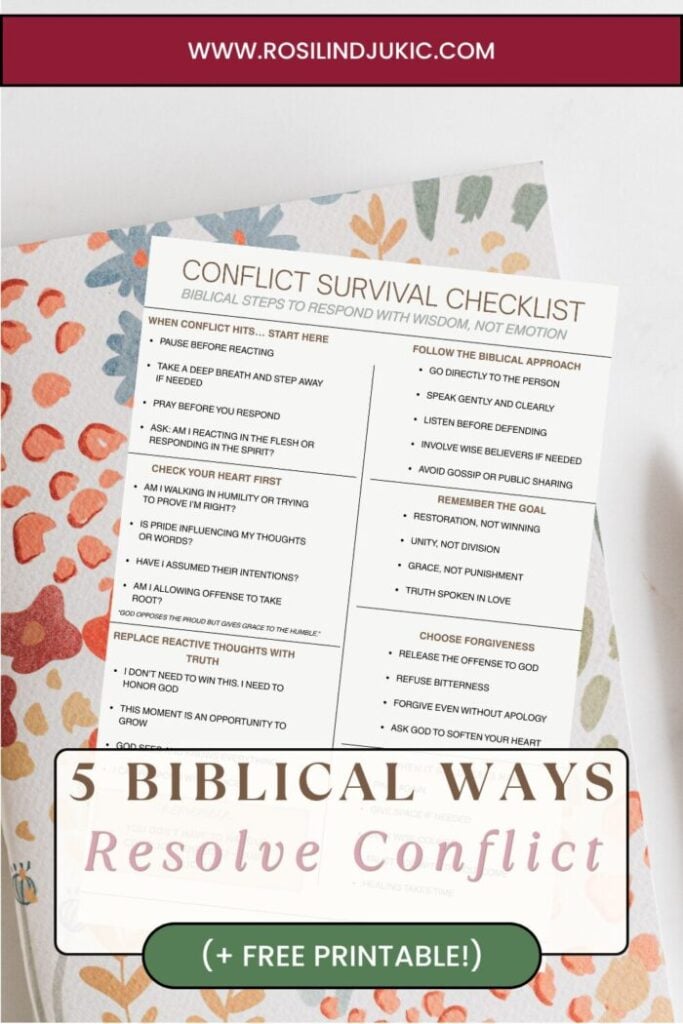
Conflict Survival Checklist (Free Printable)
So instead of trying to remember all of this in the heat of the moment…
I created a simple Conflict Survival Checklist you can keep nearby.
This printable will help you:
✔ Respond calmly instead of reacting emotionally
✔ Follow a biblical process step-by-step
✔ Keep your heart aligned with God—even in difficult conversations
👉 Click here to download your free Conflict Survival Checklist
(or grab it from the image below)
Get access to my entire Resource Library of over 100 resources without having to opt in when you join my Resource Library (available also on Buy Me a Coffee). These resources include: journals, workbooks, worksheets, Bible verse cards, bookmarks, and more!



I like the fact that grace is endless.
Me too!!
“Forgiveness is bottomless, grace is endless. ” I strive to forgive, always, but sometimes it takes me a bit. I want to be forgiven so I need to give it also. I am just too human.
Ye s- we are all human. We need to give since we’re such recipients of abundant grace.
I have forgiven other Christians and non-Christians for offenses against me. Does the scriptures say you must trust these people again especially when they continue to hurt or offend, lie or abuse you?
I feel a person would be wiser to avoid such persons and turn them over to the Lord, while continuing to pray for them. Let the Lord deal with them and get on with your life.
When we continue to plead with some people to repent, it becomes a game for them and gives them great satisfaction to keep up the torment. If they are left to think about their behavior, sometimes they will come around and repent.
No – nowhere does scripture say that we must trust those again who have abused or lied to us. Sometimes the wisest thing we can do is to put up boundaries. I do believe that scripturally we need to follow Matthew 18 – even the confrontational part – but if we see that they remain unresponsive or unrepentant we need to move on. Definitely. But we also need to take care that our heart remains free from bitterness. And sometimes the best way this happens is to continue to pray for them from a distance.
Thank you! These are some timely words for me to remember. This week feels like one constant barrage and there has been so much room for mercy, grace and forgiveness, all around. I’m grateful for your post here! Thank you for sharing with us at Grace & Truth!
I am sorry you’ve had a hard week. I’ve been there…when it seems like its one thing after another. I pray that this week has been easier. Yes – so much room for mercy, grace and forgiveness.
What if the offense has taken a toll on your mental health? What if it is abusive?
This is a very good question, actually, because there are some conflicts we cannot resolve. And what do we do in those situations where the offender is aggressive or abusive? We need to use boundaries. In this series I talk about how to build healthy relationships and what to do when we have toxic people in our lives. I hope that it helps you. https://rosilindjukic.com/tag/building-healthy-relationships/
I love what you said about forgiveness, that is powerful and I am sure God agrees!