

5 Ways We See Jesus in the Tabernacle
I hope you love the products and resources I recommend here at A Little R & R. Just so you know, it is possible that I get a commission and collect income from the links on this page. As an Amazon Associate I earn from qualifying purchases. Click here for more info.
Have you ever realized how much the story of Jesus is hidden in the Old Testament?
One of my Bible professors used to often quote, “The Old Testament is the New Testament concealed, the New Testament is the Old Testament revealed”.
I know there are those pastors who tell us we need to “unhitch” from the Old Testament and that it is no longer relevant to us today as “New Testament believers”.
There are those who believe that because we are not under the law, but under grace, the Old Testament serves more as a biblical historical account.
Nothing can be further from the truth.
Yes, Jesus fulfilled the ceremonial laws – the set of laws that directed worship and sacrifice. However, the civil and moral laws that direct our moral values and social interactions still stand.
When you read the Old Testament, you can see Jesus immediately from the Garden of Eden, in the story of Abraham and Isaac, and through the Israelites wandering in the desert.
Yet, one of the most fascinating ways we see Jesus is in the tabernacle.
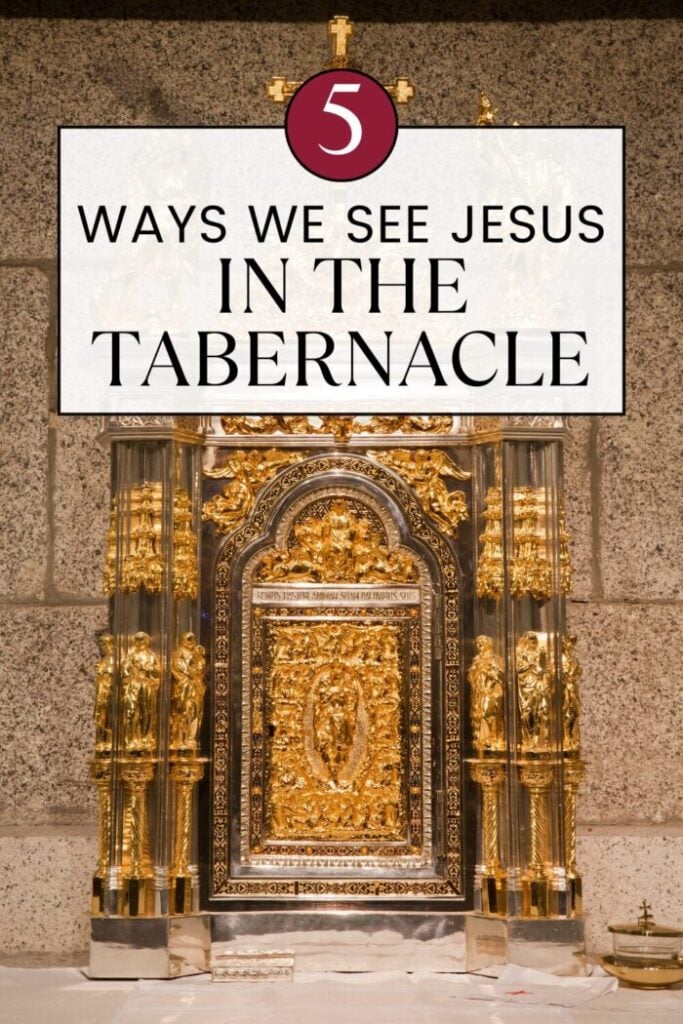
In order to understand the symbolism of Jesus in the Tabernacle, we need to get a picture of what the Tabernacle looked like.
5 Ways We See Jesus in the Tabernacle
Around the temple was a courtyard where the people gathered.
They were not allowed inside the Tabernacle, because that was reserved for the priests who wore special garments. God was very specific about this.
The Israelites had rejected God at Mt. Sinai and requested that God not speak directly to them. I wonder how differently the Tabernacle might have looked had they not rejected God.
As the priests entered the Tabernacle, they were first greeted with the altar of sacrifice.
On this altar, they brought the animal and grain sacrifices – this is important to know because there is a second altar that has a completely different purpose.
After that, there was a laver filled with water so they could wash themselves before entering the holy place.
Finally, there was the Holy Place and then the Holy of Holies, where only the High Priest could enter.
In the Holy place was the table of showbread, on which were 12 loaves of bread representing the 12 tribes of Israel, and opposite to the table was the golden lampstand that was to never go out.
Right in front of the Holy of Holies was the altar of incense. On this altar, they were never to offer sacrifices or burn anything other than the special incense – a recipe that God had given to them.
The Holy of Holies housed the Ark of the Covenant that held the 10 Commandments, a jar of manna, and Aaron’s staff that had budded.
God’s presence dwelt in the Ark.
1. Jesus is our final sacrifice
No longer do we have to sacrifice animals on an altar to cover our sin. No longer do we have to bring sacrifices of thanks or offer firstfruits.
Jesus’ blood offered the final sacrifice for sin.
His blood has completely removed our sin, opening the door to a personal relationship with the Father as a friend talks with a friend.
2. Jesus – the Word – washes us
John 1:1 says, “In the beginning was the Word, and the Word was with God, and the Word was God.”
Paul says about Christ, in Ephesians 5:26, “that He might sanctify and cleanse her with the washing of water by the word,”
As we daily read the Word, it cleanses us, it refreshes us, and just as the laver also served as a mirror for the priests to examine themselves, it reflects back to us our image compared to Christ.
This is why James warned us in James 1:22-25 “But be doers of the word, and not hearers only, deceiving yourselves. For if anyone is a hearer of the word and not a doer, he is like a man observing his natural face in a mirror; for he observes himself, goes away, and immediately forgets what kind of man he was. But he who looks into the perfect law of liberty and continues in it, and is not a forgetful hearer but a doer of the work, this one will be blessed in what he does.”
3. Jesus is the bread of life
When Jesus was tempted in the desert, he quoted Moses from Deuteronomy 8:3, “that He might make you know that man shall not live by bread alone; but man lives by every word that proceeds from the mouth of the Lord.”
One thing I often ask myself is, “What do I turn to for satisfaction?“
In other words, am I living by my appetites (bread alone)? Am I living out of my emotions or will?
In John 6:35, Jesus said, “I am the bread of life. He who comes to Me shall never hunger, and he who believes in Me shall never thirst.”
Jesus, the bread of life, satisfies us completely and eternally.
Once we’ve “tasted and seen that the Lord is good”, we don’t need another source of satisfaction.
4. Jesus is the light of the world
The golden lampstand lit the Holy Place for the High Priest, and the flame was never to go out.
Jesus said of Himself in John 8:12, “I am the light of the world. He who follows Me shall not walk in darkness, but have the light of life.”
However, he also said in Matthew 5:14, “You are the light of the world. A city that is set on a hill cannot be hidden.”
Not only is Jesus the light of the world, but when we walk in Him, His light shines through us to a world that needs His light.
We don’t have to walk in darkness, hoping that we don’t bump up against obstacles or stumble over sin and temptation.
When we follow Christ, He will illuminate our path so that we can see the obstacles in our path.
Paul reminds us that there is no temptation that comes our way that is not paired with an escape route. We don’t have to fall into temptation.
Jesus – the light of the world – lights our path so we can see that escape route and avoid temptation.
5. Jesus opened the way to the presence of the Father
There was a thick curtain that hung between the Holy Place and the Holy of Holies.
The children of Israel were not allowed into the Holy of Holies at all. Only the high priest was allowed into the Holy of Holies, and even then, only once a year.
However, when Jesus died, the curtain that divided the Holy Place from the Holy of Holies was torn in two, opening the way for mankind to freely enter God’s presence.
No longer was the Holy of Holies reserved for the High Priest; all could freely enter because Jesus – by this single act – became the way to the Father for all who would come.
When we are saved, we become the temple of the Holy Spirit. We are made holy because the blood of Jesus makes us holy.
We are not holy because of what we do or don’t do. We are made righteous and holy by the blood of Jesus that grants us full and complete access to the Father.
We are accepted in the beloved and are made holy by His blood!
Knowing this, as we read through the Old Testament, we get a whole new picture of the temple, making each story come alive.
Reading the Old Testament becomes a treasure hunt, as we look to see how Christ is hidden and woven throughout each story and each event.
In this 30 Names of Jesus Scripture Writing Challenge, you will be led to meditate on the many names of Jesus we see in Scripture and use Jesus’ names in prayer and Scripture writing.
Get the 30 Names of Jesus Scripture Writing Challenge today when you click here or on the image below.


I found your posts on the “Tell It To Me Tuesday” Linky Party. I’m glad I did. I enjoyed both of them. Thanks for sharing.
Thank you for stopping by!!
I have to say that I completely agree that there’s so much “exciting stuff” in the Old Testament. It’s often buried a bit beneath some layers of details, symbolic language, and hard-to-pronounce names. It takes some digging…some pondering…and perhaps even a bit of background study. But it’s so worth it as we uncover the priceless nuggets below the surface. Thank you for this lesson about the tabernacle, and for linking up with us at Grace & Truth.
Oh yes – it is always worth the time it takes to dig out those treasures. I love it! The Word is living…always deepening, but never changing!